
Awareness
- What you hear
- “Another new tool. Why, exactly?”
- What is needed
- Meaning: why this matters to our goal
- What I do
- Kick-off and team workshop on why we are doing this
- What you get
- Core narrative and baseline assessment
AI adoption & implementation
You have the licences. Some of the team are experimenting enthusiastically; others do not know where to start. I help turn this into one shared approach: from discovery to working agents and workflows, with people who can take them further themselves.
An agent is an AI assistant that carries out a task in steps.
Through my own practice and previous roles.















Some people are hesitant; others are experimenting without coordination.
Pilots that never get beyond the demo and become part of everyday work.
Only two or three people know what is and is not allowed with data and AI.
People, processes and technology
The why and the question “what will be left of my profession?” determine whether people start building.
Work that genuinely changes, with owners and ground rules.
The simplest form that works, in the environment you already have. With tests defined in advance.
BCG uses 10-20-70: 10% algorithms, 20% technology and data, 70% people and processes. A practical rule of thumb, not a measured law.
Where adoption falters
I use ADKAR: five steps a person goes through before a new way of working sticks. The first step that falters tells you where to intervene.
| Awareness | Desire | This is where training fitsKnowledge | This is where training fitsAbility | Reinforcement | |
|---|---|---|---|---|---|
| What you hear | “Another new tool. Why, exactly?” | “What does this mean for my profession?” | “I want to, but where do I start?” | “It worked in the training. Not on Monday.” | “After three weeks, everyone is doing things the old way again.” |
| What is needed | Meaning: why this matters to our goal | Autonomy and mastery: a say in how your work changes | Relevance: knowledge applied to your own tasks, beyond a generic demo | Time and colleagues: practising together on real work | A system that rewards the new behaviour |
| What I do | Kick-off and team workshop on why we are doing this | Interviews and a first demo using your own tasks | Workshops using your own tasks and use cases | Training on real work, peer learning and sharing what goes wrong too | Adjust roles, routines and recognition together with managers |
| What you get | Core narrative and baseline assessment | Team-level diagnosis | Use case backlog | Proven ways of working | Reinforcement plan and follow-up assessment |
This is where training fits
This is where training fits
Based on ADKAR (Prosci), supplemented with my own working model.
Model: ADKAR (Prosci). Change succeeds for each person through five successive steps. The first step that falters tells you where to intervene. Supplemented with Drive (Daniel Pink), Bas Kemme (IntotheNXT, 2026) and the 4D AI Fluency Framework by Rick Dakan and Joseph Feller (CC BY-NC-SA 4.0). The connection is my own working model.
The statements are typical examples, not client quotes.
How I work
Interviews, workshops and a team profile. A catalogue of opportunities from across the organisation, beyond a single enthusiastic user.
What must AI not do? Who decides? Where does the data stay? Your IT lead's boundaries are the starting point.
Assistants, agents and workflows. The simplest form first, with tests defined up front and short feedback cycles.
Guides and support. Team members who start building their own agents.
I work with the software you already use. Want an AI environment set up with your organisation’s knowledge and clear ground rules? Tisser offers that. I co-founded the company and now work with it as an implementation and adoption partner.
AI adoption · Investment firm
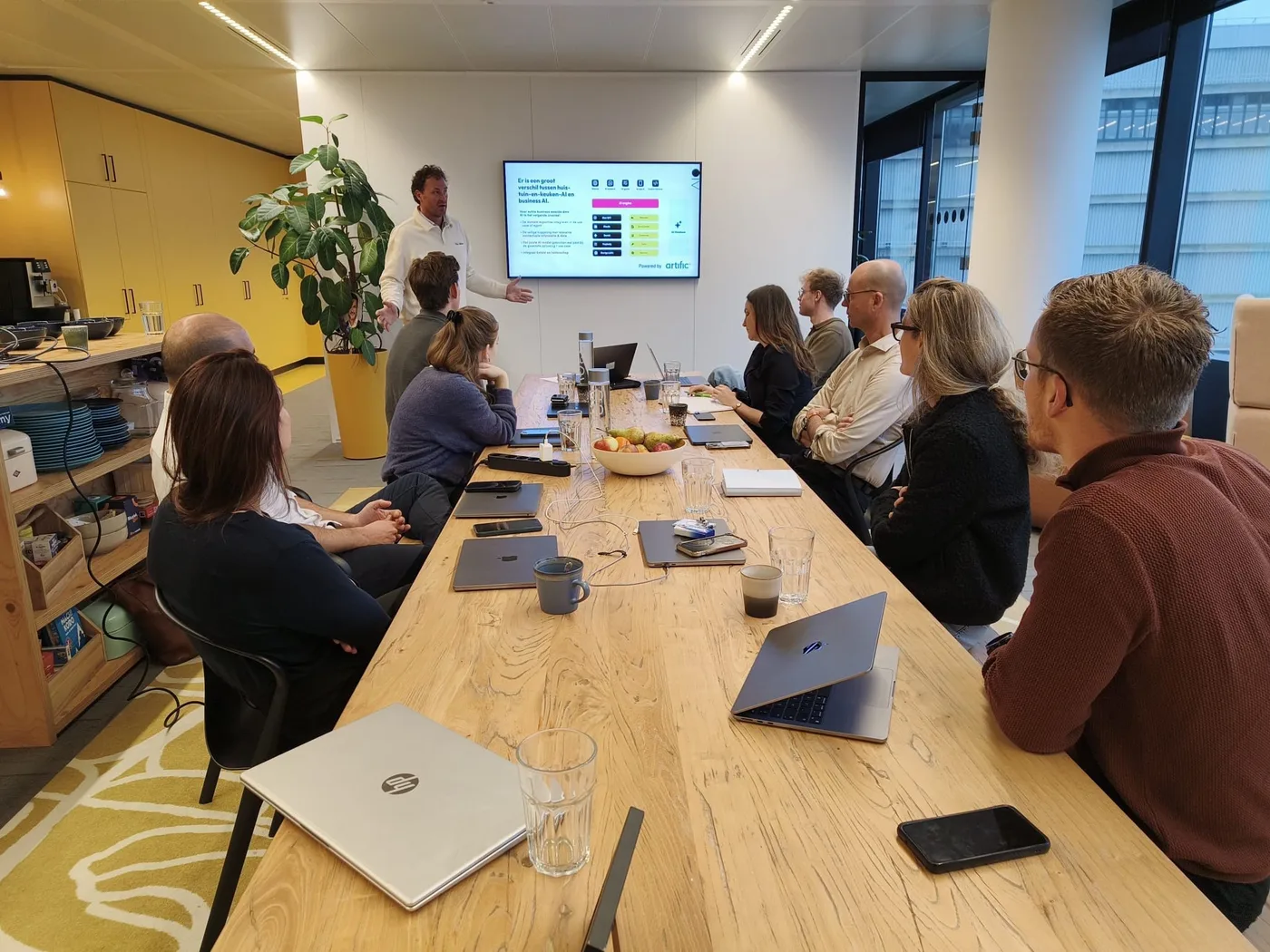
Some were hesitant, others were running isolated AI experiments. I helped the team develop a shared approach to Microsoft Copilot and AI, with ground rules and initial applications. Three agents are now running, and colleagues are building new ones themselves.
Through an agency · anonymous
Eight interviews, 31 use cases with an owner and a route, a workshop and a keynote.
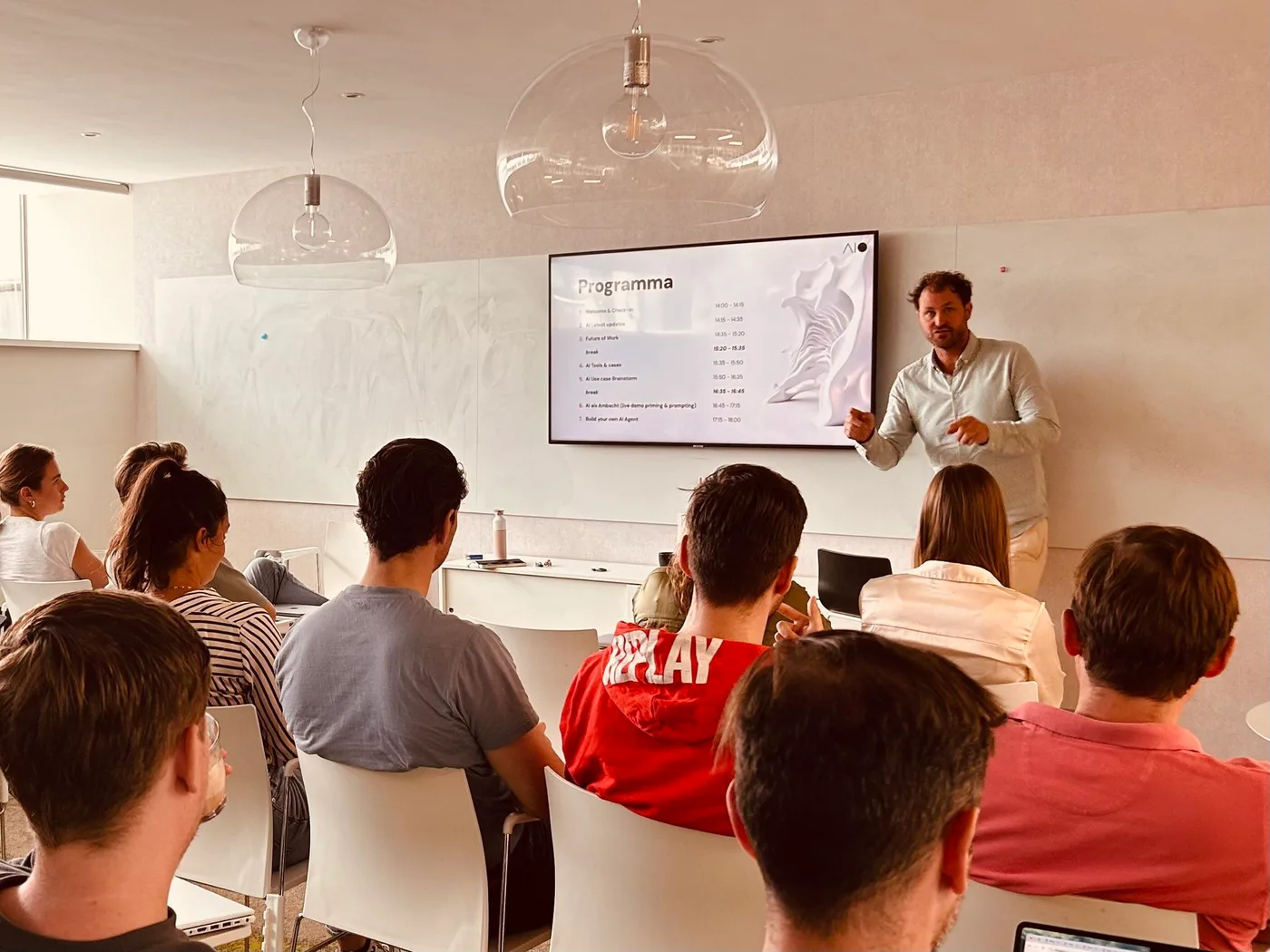
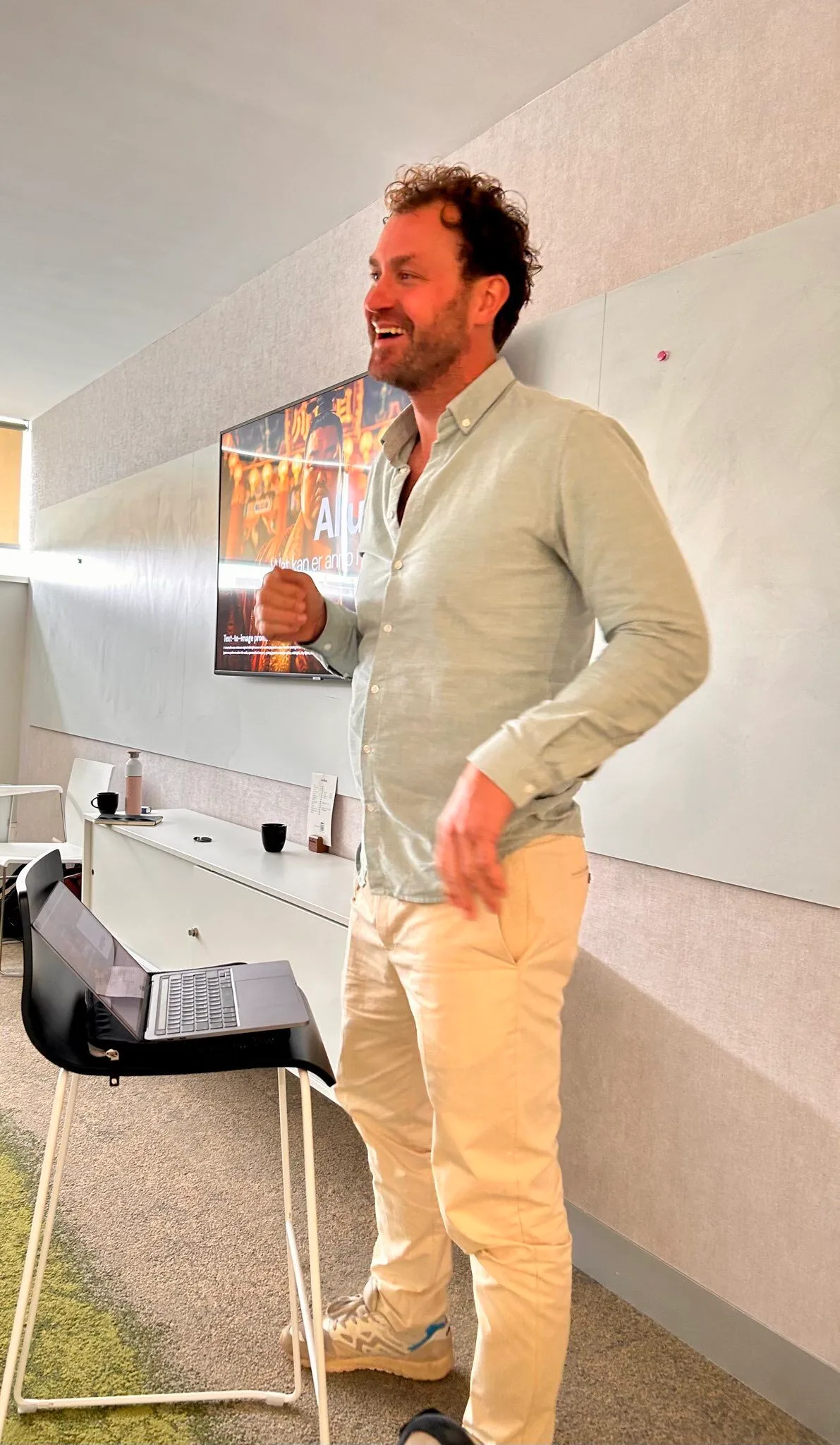
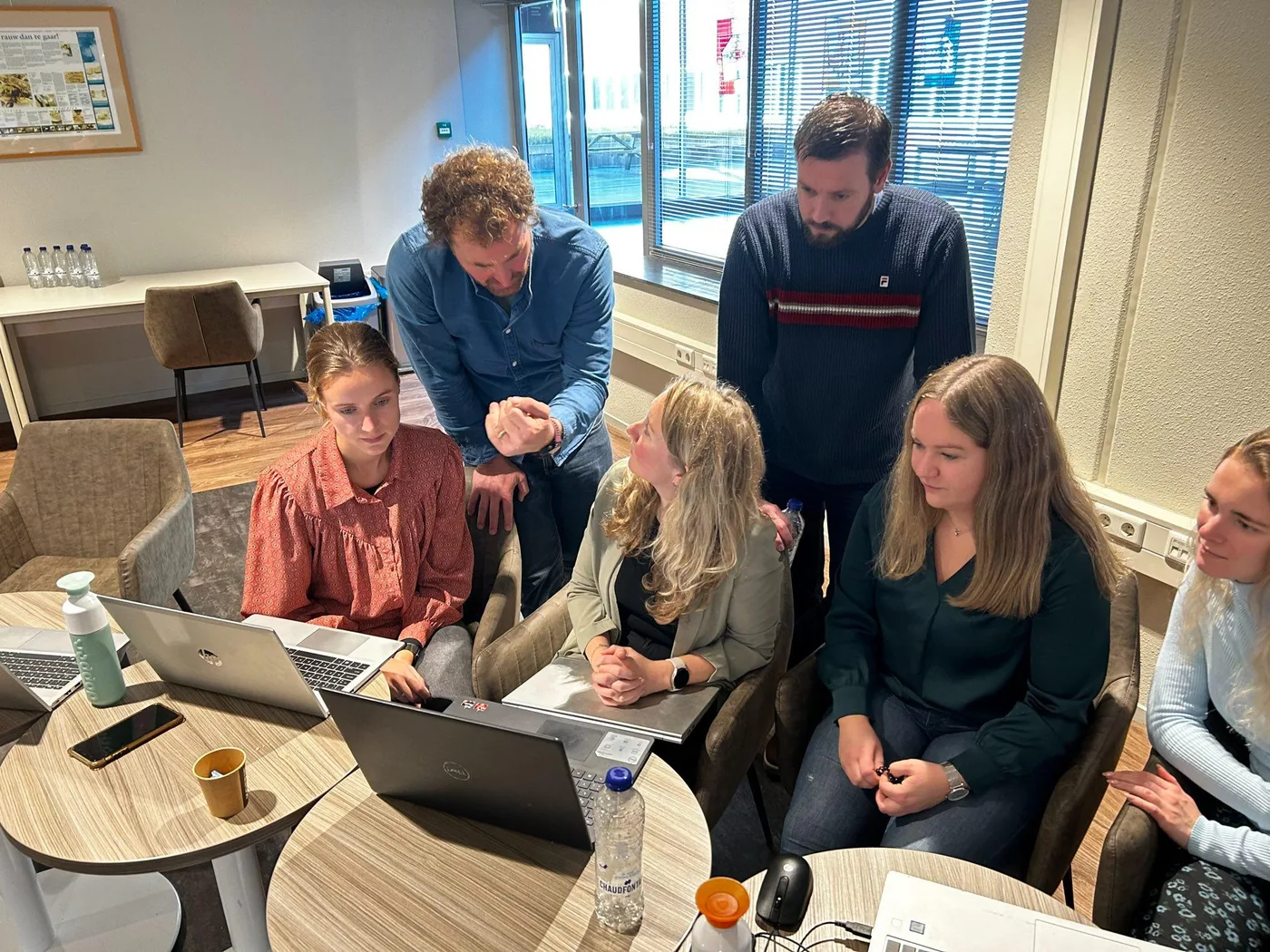
AI workshop with Thierry
“Thierry made AI tangible for our work as an agency. With humour, examples and vision.”
Translated from Dutch
Summary of the review: Peter says Thierry's enthusiasm inspired him to start using AI that very evening.
Everyone responds anonymously to five short statements. You see where each team is getting stuck and what the first step should be. After six to eight weeks, we measure again.
Within a few weeks, a list of opportunities with owners, and a plan for the order in which to tackle them.
usually six months, three days a week. We build, test and hand over.
Let's get started
The adoption scan shows you for each team.